Archive » August 2018 » Mary Ellen Johnson

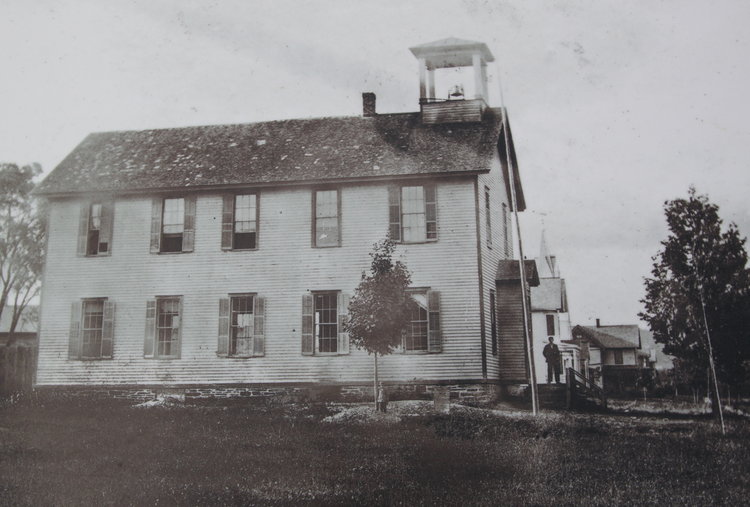
This bell not only rang for classes, but was reputed to ring mysteriously on Halloween. Here it is visible in the cupola atop Guilderland District 4 School on Willow Street. The empty cupola remains on the building now housing a New York State Police substation.

Many decades ago, peals of bells housed in cupolas atop local schoolhouses signaled dawdling children that classes were about to begin. Once standard equipment for old-time schools, most school bells have disappeared along with most of the school buildings where they once hung. Fortunately, a few of Guilderland’s historic school bells have survived.

In 1900, Guilderland’s several common school districts were scattered throughout the town to be within children’s walking distance from home, offering education up through eighth grade.

With district numbers in parenthesis, they were: Settles Hill (1), Dunnsville (2), Parkers Corners (3), Hamlet of Guilderland (4), Wormer School (5), Guilderland Center (6), Altamont (7), Gardner Road School (8), Osborn Corners (9), Cobblestone School on Stone Road (10), McKownville (11), McKownville Annex (11A), Fullers (13), and Fort Hunter Bigsbee School (14).

District 12 had disbanded in the 1890s, followed by the closure of the Wormer School in 1906. By 1902, Altamont had become a Union Free District and had opened its high school.

Early in the 1930s, New York State began to urge rural areas with many small local districts like Guilderland’s to merge into centralized districts, doing away with old-fashioned, one-room schools and offering modern high school education.

In 1941, the Voorheesville schools centralized, including Guilderland districts 5, 8, and 10. That same year, Guilderland Center residents voted to pay tuition, enabling their children to attend Voorheesville schools even though they didn’t become part of that central district.

Eventually, Guilderland’s remaining districts plus North Bethlehem voted to form the Guilderland Central School District in 1950. Once modern Fort Hunter, Altamont, and Westmere elementary schools opened in 1953, the old one-room schools were auctioned off.

Whatever became of the school bells?

Parker Corners bell to inspire modern scholars

Hidden away in a grass-covered courtyard at Guilderland High School rests the bell that once warned the little scholars attending the Parkers Corners District 3 School that classes were about to begin. The three-foot high bronze bell, cast in 1864, is inscribed in raised lettering, “Joy and gladness shall be found therein, Thanksgiving and the voice of melody.”

The bell is 33 inches in diameter and originally called worshippers to the Old State Road Methodist Church. Charles Parker, a wealthy New York City man who lived for a time in the area, donated $4,000 in 1864 to build a Methodist Church near his home. At that time, a church bell was purchased from Jones and Company Bell Foundry of Troy, a foundry in operation from 1852 to 1887. By the late 1930s, the dwindling congregation forced closure of the church.

Nearby on West Old State Road stood the Parkers Corners one-room school where one November morning in 1942 fire erupted just as pupils were arriving. While desks, books, and the adjoining wood shed were saved by neighbors’ immediate action, the building was a total loss.

Realizing that, due to World War II shortages, there was no chance of arranging the transportation of students to another district, residents quickly noted the empty church building in their midst would be the perfect solution. The former church served as the Parkers Corners School until 1953 when students began attending Fort Hunter Elementary School.

After having been sold at auction, the building burned in a suspicious fire, but not before the bell had been removed to be placed by the flagpole near the front of the new Guilderland Junior-Senior High School when it opened in 1954. The bell was to serve as a “symbolic link of the ten former common school districts with the new centralization.” Today, because of the extensive expansion of the high school building over the years, the bell is now in an enclosed courtyard.

Guilderland bell traveled to Greece

The trip from Parkers Corners to the new junior-senior high school was a short one compared to the journey traveled by the bell from the Guilderland District 4 School.

In 1847, the District 4 School became the town’s first two-room school. When the building was remodeled and enlarged in the 1890s, it boasted a “fine” new bell donated by village residents Messrs. Newberry and Chapman, owners of the Guilderland foundry. Because casting bells was such a specialized operation, it is unlikely the bell was cast at their foundry.

After the 1953 opening of Westmere Elementary School, the Willow Street school building served as Guilderland’s first real town hall before becoming a State Police substation.

As Nazi invaders swept through Greece in 1941, they confiscated anything that could be of value to their war effort, including the bell that hung in St. Nicholas Church in the small Macedonian village of Siatista. Communist unrest in that area of Greece during the years immediately following the war prevented the villagers from replacing their cherished bell.

Mrs. F.C. Cargill of Guilderland became aware of the village’s loss and knew that the Society of Siatisteon Siatista, a New York City group of former Siatista village residents, sought a replacement bell. She contacted William D. Borden, president of the Guilderland Board of Education to inquire if one of the district’s old school bells could be donated.

The board quickly approved, giving the bell from the Guilderland District 4 School to the society which took over the responsibility and cost of shipping the bell to Greece. After its arrival, the bishop sent a gracious thank-you for the bell to the board of education saying, “By its sacred tolling it may summon Christians to worship God.”

Dunnsville bell at Town Hall

The Dunnsville District 2 one-room school dated back to 1875 when it replaced an earlier 1820 building. In 1882, a bell cast at the Clinton H. Meneely Bell Company, a Troy bell foundry, was placed in the cupola of the new school where it rang out 15 minutes before classes began, again at class time, and then again at noon.

Viola Crounse Gray, a Dunnsville student in the early 1900s, recalled her father and other local farmers coming in from their chores for their midday meal at the sound of the school’s noon bell. As the last trustee of the school, in 1953 she had the opportunity to purchase any school property not needed by the district.

Sentimentally, she wanted the bell she remembered so fondly from her childhood. In 1982, when she and her husband, Earl Gray, offered the bell to the town, it was placed in front of Town Hall.

Stone Road bell at historic house

Once ringing out from above the Cobblestone District 10 School on Stone Road, today the school’s 320-pound bell rests silently in front of the Mynderse-Frederick House. Because this Guilderland district became part of the Voorheesville Central School District, it isn’t clear when the building ceased being used as a school and became a private residence.

At some point, its bell came into the possession of the Albany Institute of History and Art, later passing into the hands of the Christ Lutheran Church in McKownville. When the bell proved too heavy to place in the church’s bell tower, it languished in a storeroom for 30 years.

Eventually, the church historian got in touch with then-Town Historian Fred Hillenbrand to offer the bell to the town. After Guilderland Highway Department workers refurbished the bell, cast in 1868 at the Meneely Bell Foundry of West Troy (after 1896 renamed City of Watervliet), it was placed in its newest location in front of the Mynderse-Frederick House.

Cobblestone school still has its bell

To have a genuine glimpse of the past, observe the old Cobblestone District 6 School in Guilderland Center with its bell still in its cupola as you drive by on Route 146. The building was erected in 1867 and is still owned by Guilderland Central School District.

During the period of time when these rural schools were built, the cities of the Capital District were manufacturing centers employing countless workers. Among the factories in Troy and West Troy (Watervliet) were bell foundries turning out thousands of bells sold all over the country for schools, churches, and government buildings.

When you pass by the bells at Town Hall or in front of the Mynderse-Frederick House, remember the early system of common-school education they represented as well as the industry that was once so important to this area.

Location:

Tags:

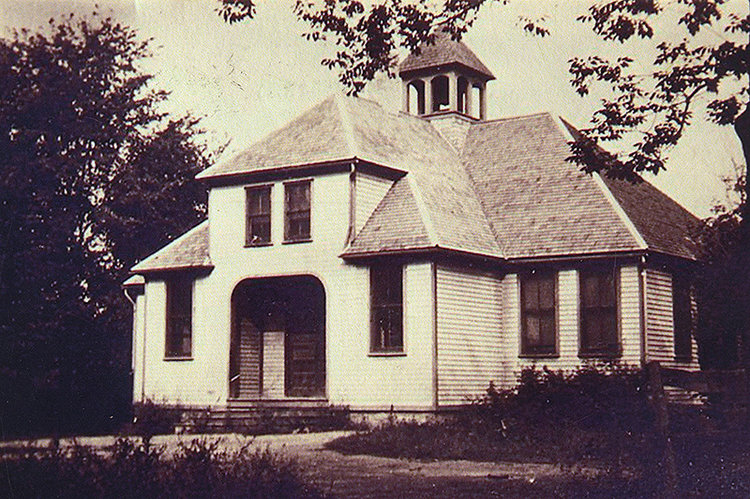
Now an apartment building at 131 Maple Ave. in Altamont, the District 7 common school building, built in 1879, once stood on School Street (now Lincoln Avenue). After the Altamont Free Union School opened in 1902, James Keenholts bought the old school building at auction for $875 and had it moved to Maple Avenue.

America’s advances in technology and the growth of business activities at the opening of the 20th Century made it obvious that educational skills beyond those offered by the traditional eighth-grade common schools, then typical in New York’s rural communities, were needed.

Altamont’s School Street (later renamed Lincoln Avenue) had been the site of District 7 common school since 1879, but by 1901 many in this prosperous and expanding village were questioning the adequacy of the education received there by the village’s youth.

Calling a meeting of taxpayers in early April 1901, school trustees sought a consensus either to repair the current school building or to choose a different site and erect a new one. The trustees had heard complaints about the poor and limited quality of education available in the District 7 common school, often deterring outsiders from settling in the otherwise up-and-coming village and forcing villagers to send their children to board in the city if they wished them to get schooling beyond eighth grade.

The trustees made it clear they had hopes of winning approval for a new building large enough to allow Altamont to eventually become a union free school district permitting a high school department. Uneasy taxpayers were assured that enough non-resident students would attend a high school, paying tuition to defray any additional expenses.

The special meeting brought out a sizable number including a few taxpayers who were no happier at the thought of higher school taxes than taxpayers a century later. One suspicious attendee demanded to know why the meeting had been called.

In answer, one trustee read to the assembled group a letter received from the State Department “calling attention to the deplorable condition of the school building and grounds.” A resolution was made to raise $500 to repair the old school but, when it was pointed out that the meeting was not called according to a state law that mandated school meeting notices could only be issued by a person who is also a taxpayer, the resolution died.

With that, the meeting became an informal gathering where the talk drifted over to the need not only for a modern school building, but a school that would offer more advanced studies than the common school.  W.S. Keenholts, one of the school trustees who obviously had come prepared, immediately launched into the requirements that applied to a union free district, legally necessary to establish a high school in New York State.

At that, attendees signed a petition almost unanimously for the trustees to call a second meeting to have an official vote on becoming a union free district. The sentiment seemed clear that Altamont needed a new building offering a higher level of education to keep up with the times.

As the meeting approached when legally eligible voters would decide the question of becoming a union free district, arguments in favor appeared in The Enterprise. “Progressive up-to-date people of the district” not only felt it was a good business proposition, but would give more children the opportunity to get an advanced education.

The old attitude that the eight-grade common school was good enough for my father and good enough for me was “false reasoning.” A comparison between the old common school and the academic department of a union free school made it clear “more extensive book knowledge” was a necessity in “the professional, the industrial, the commercial and the political world” of that day.

The night of the meeting, Mr. Thomas E. Finnegan of the New York State Department of Public Instruction and two other men representing communities that already had become union free districts spoke of the advantages of this type of district.

Advocates of change triumphed when the votes in favor of the new type of district were 124 to 14. A board of education was elected to look into a site and plan for a new building.

By early July 1901, the board of education called a meeting with plans for a new school building and the necessity of raising the sum of $10,200 for construction costs. In addition, $1,800 would be needed for heating and sanitation, and $500 for furnishings in the new building. An additional $800 had to be raised to purchase a two-acre plot on the corner of Grand Street and Fairview Avenue. It was planned to issue bonds to be paid off $1,000 plus interest annually.

The building’s architect was Altamont resident Wilber D. Wright. The notice calling for contractors to submit bids called for an eight-room, two-story school building of solid brick, 50-by-78 feet with a basement. It was to have the capacity for 250 students.

No bid was as low as the figure set by the board of education but, after a way was found to get the additional $3,000, the construction contract was awarded to the lowest bidder, Mr. J.W. Packer of Oneonta.

The old school was auctioned off in 1902 once it was no longer needed, purchased by James Keenholts for $875. Soon after this, he had the building moved over vacant lots to Maple Avenue.

By October 1901, Crannell Brothers, then located in Altamont, had brought in D&H carloads of lumber and Rosendale cement. Work on a foundation of bluestone brought from Fred V. Whipple’s quarry was soon underway.

Many spectators walked over to Grand Street during the next few months to observe the construction progress. Once the exterior was complete, Altamont’s A.J. Manchester installed the heating and plumbing while George T. Weaver put in lathing and plastering. By early summer 1902, the building was completed and formally accepted by the board of education.

The principal of the new school was Professor Arthur Z. Boothby, who had already been hired by the district fresh out of Albany Normal School in 1900. His salary for 1901-02 was $540.40.

Also on the faculty were several women who earned in the $300 range. A janitor had also been hired. The total school budget adopted by the board of education for 1902-03 was $2,495.50.

With the school’s opening imminent, the school board put out publicity, encouraging out-of-town tuition-paying students to attend. Promoting the new school as having “all the latest in equipment in sanitary arrangements and provided with all necessary apparatus for pursuing higher studies,” enrolled students were to be taught by a “competent corps of instructors.”

Tuition rates for non-resident students were given per quarter: academic, $2.50; intermediate, $2.50; and primary, $1.75. For those living along the D&H line, commutation per month was: Delanson, $3.00; Duane, $2.50; Voorheesville, $3.00; and Meadowdale, $2.50. While the costs of construction, personnel, and commutation seem very low, these figures are for 1902 dollars.

A general invitation went out to Altamont’s villagers, urging them to attend the dedication ceremony on Sept. 18, 1902 when the school building would be open for people to wander through. Even though the weather that day turned out to be rainy and unpleasant, a large crowd turned out to participate in opening ceremonies held in the large assembly room.

The program included prayers; scripture readings; and speeches, followed by Dr. Jesse Crounse, president of the Board of Education, who reviewed the rules of the school including one holding the parent or guardian responsible for any damage done by a child to furniture or the building.

School opened Monday with an enrollment of 154 pupils (this number included Altamont’s elementary grades as well) including 10 non-residents. The high school’s first graduating class in 1905 had 11 graduates.

By rights, Altamont residents were extremely proud of their new school, built at great financial cost for such a small village. The school was in use until the centralization of Guilderland’s schools took place in 1950.

By 1953, the new Altamont Elementary School, built on the same plot of land as the old Union Free School, and a year later Guilderland Junior-Senior High School in Guilderland Center were open. The once-modern building in Altamont stood empty.

In December 1955, when it was decided there could be no possible future use for the structure, the board of education of the Guilderland Central School District awarded Jackson Tree Service a contract to demolish and remove the debris of the grand old building for a bid of $3,250.

A New York State Historic Marker stands on Grand Street to indicate where the Altamont Union Free School once stood. It is ironic to think the solidly constructed school was razed, replaced by a lawn and a marker, while the inadequate District 7 common school building is still standing today at 131 Maple Ave. and is now used for residences.

Location:

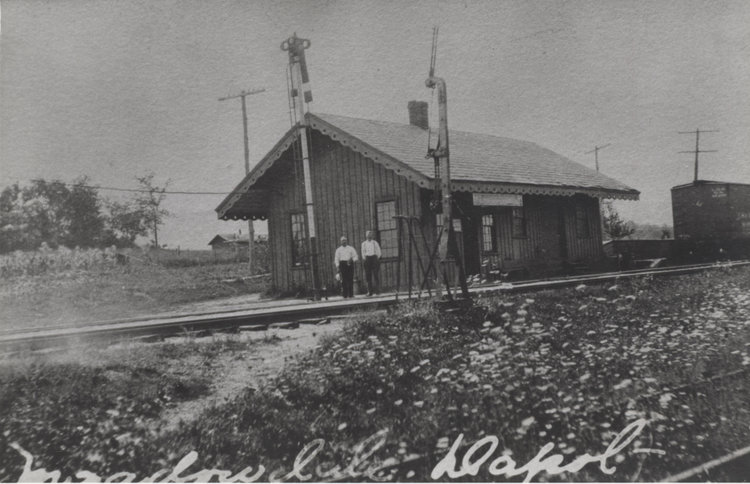
Just in from the west side of Meadowdale Road, the small Meadowdale Depot stood south of the D&H tracks behind the stationmaster’s house. This photograph of the station appeared on a postcard.

Without a GPS to route them to Meadowdale, Gardner, or Frederick roads, few current Guilderland residents could find their way to Meadowdale, and once there would wonder: What’s Meadowdale?

Although difficult for us to believe today, a century ago Meadowdale was one of Guilderland’s small hamlets with an identity all its own, reflected in its little weekly column in The Altamont Enterprise.

In the 18th and early 19th centuries, the locale was an area of scattered farms tenanted by leaseholders of the Van Rensselaer West Manor. With the Helderberg escarpment rising just to the west and the Black Creek meandering through the fertile farmland, it was a very scenic spot.

A site was chosen here to become the only stop on the Albany & Susquehanna Railroad between Voorheesville and Knowersville when the railroad laid track through that part of Guilderland in 1863.

Within a year, a small passenger depot and freight office was erected in a location where the tracks crossed a dirt road now called Meadowdale Road; the sign hanging from it identified the stop as Guilderland Station.

A few years later, the A&S Railroad was absorbed by the Delaware & Hudson Railroad. A sizable amount of the D&H’s profits stemmed from summer passenger service: group excursions, day trippers off to a scenic spot, urban vacationers either boarding at country hotels or with farm families who took in summer boarders for extra income.

The logic of D&H executives renaming the stop from its original pedestrian name Guilderland Station to the more attractive sounding Meadowdale is obvious. Annually, the company published the “D&H Directory of Summer Hotels and Boarding Houses” where the prospect of stopping at Meadowdale would certainly seem lots more appealing to prospective visitors.

Each sunny weekend, numerous day trippers came out from Albany to the little depot, planning to hike the two to three miles up the “old road” through Indian Ladder Pass to the top of the escarpment. An Altamont livery stable owner usually would send over one of his wagons to transport for a small fee those who were unable to do the vigorous hike themselves up the escarpment road. At the end of the day, the weary hikers journeyed back to Albany after their day in the country.

Boarding houses on Thompson’s Lake would often send a wagon to pick up expected guests as well. And farmers came by to pick up boarders who were coming to stay a week or more at their farms.

In later years, many Boy Scout troops came to hike up and camp out on top of the escarpment. Local trains were frequent and inexpensive with a 1909 timetable listing fares with the price of a round-trip ticket from Albany to Meadowdale 79 cents while one way was 42 cents.

By 1900, the area around the little depot had become a much bigger railroad complex with a water tower across the tracks, a necessity in those days of steam locomotives. Nearby was a utility shed for storage of track maintenance equipment and across the tracks from the depot was a freight yard where numerous freight cars that brought up coal from Pennsylvania mines could be parked until the fuel was needed to feed the fire boxes of D&H locomotives.

For many years, large quantities of hay was shipped out of Meadowdale, a major profit-making crop for local farmers during those horse-drawn years.

In the 1886 Howell & Tenney History of Albany County, the name is still given as Guilderland Station, characterized as “a hamlet of about 100 people,” with two dealers in cut hay, a blacksmith and a “general merchant.”

A few years later, in 1897, when Landmarks of Albany County was published, rather confusingly Guilderland Station get a one-line paragraph saying it was a small hamlet with no post office with a second one-line paragraph following, mentioning Meadow Dale as a hamlet with a post office in the “extreme southern part of town” — strange since both the store and the postmaster who ran the post office in his own home were only a few hundred feet from the depot.

Soon after the opening of the depot, a Guilderland Station post office was established there in August 1864 and renamed Meadowdale in 1887. While at first the post office was actually in the railroad station, it was later either in the postmaster’s house or more commonly in the community’s general store.

Most of the mail was generated by summer visitors who hiked up the escarpment or were boarding with local farmers. The photograph of the railroad depot appeared on an early 20th Century postcard, one of many sent out with a Meadowdale postmark, though most were of scenes of the Indian Ladder Road or from atop the escarpment.

The general store, for many years run by William Schoolcraft and his wife, not only served folks as the post office, for groceries and other farm necessities, but also as a gathering place to exchange news and gossip. Schoolcraft traveled the area from Voorheesville to Altamont, selling groceries and picking up fresh produce.

School-age children trekked to Gardner Road to the District No. 8 one-room schoolhouse built in 1885 to replace an earlier building. The schoolhouse was not only used for education, but often hosted Sunday afternoon religious services and served as the meeting place for a Christian Endeavor group as well.

A little record book exists labeled “Meadowdale Union Bible School list of membership 1910 – 1912.”  No church was ever built in Meadowdale, and probably most people had membership in either an Altamont or Guilderland Center church, but in the horse-and-buggy era, especially in bad weather, it wasn’t feasible to go that far.

In spite of the population being spread out on farms, having the general store on one road, the schoolhouse on another, and no real center to Meadowdale, the people who lived there definitely identified as being from Meadowdale. The little Meadowdale column that appeared with regularity in The Enterprise listed the births, illnesses and deaths, farm news, social events, and endless visits back and forth.

The appearance of the automobile and the rapid growth of travel by car spelled the end of Meadowdale’s prosperity and identity. People no longer rode the train to board with local farmers or to walk up to Thacher Park as the area atop the escarpment had become by that time.

No longer having a market for hay, farmers had to switch to dairy farming or raising chickens or get out of farming entirely. Meadowdale’s store became obsolete once a short drive to Altamont’s A&P or Grand Union markets became possible. During the mid-1920s, the building that once housed the general store was dismantled and reconstructed in Voorheesville.

In 1925, the D&H Railroad, facing a major decline in profits from passenger travel, went before the New York State Public Service Commission, claiming the year before the revenue generated by the Meadowdale station was $1,424.15 while pay for the station agent there cost them $1,779.03.

In 1924, there were only 17 freight cars forwarded and one received because area agricultural production was declining. The D&H’s chief engineer presented the information that there were only six dwellings and a combination store and dwelling with a graveled road (Meadowdale Road) running through.

Seven residents appeared to protest removing the station agent and only opening the station when a train was expected, but the Public Service Commission granted the D&H’s request.

By 1931, passenger trains no longer stopped in Meadowdale and shortly after the station was taken down and the utility building moved down Meadowdale Road a short distance for someone else’s use. Today there is no trace of the station, water tower, or rail yards, though a single track still cuts across Gardner and Meadowdale roads.

In 1926, the post office was closed and residents began to receive mail delivered by Rural Free Delivery to their mail boxes. The one-room District No. 8 School educated the local children for many years, eventually becoming part of the Voorheesville Central School District.

Farmers continued to hang on in the Meadowdale area, struggling with the changes and competition in farming and the challenge of surviving the 1930s Depression.

May Crounse Kinney, written about by Melissa Hale-Spencer in The Altamont Enterprise, grew up in the Gardner Road area, attending the District No. 8 Gardner Road School until she was 14. She married local farmer Solen Kinney, farming his Gardner Road farm with him until 1949.

Her description of working 365 days a year, running her house and helping with the heavy work on the farm, planting harvesting, getting firewood, caring for animals as well as putting up 300 jars of fruit and vegetables, churning butter and sewing clothes illustrated the lives of Meadowdale farmers and their wives during the early decades of the 20th Century.

All this without electricity or telephone service until the 1940s. The first electrical lines were run out to the Meadowdale area only in 1936 by New York Power and Light Corp.

The Kinneys gave up farming when the price of newer farm machinery cost more than they could possibly afford, which is the story of most of the farmers in our area.

Today, you can drive along Meadowdale, Gardner, and Frederick roads and still see the old farmhouses and cross the railroad tracks, but Meadowdale as a community exists only in memory.
Location: